Showing posts with label quilt fabric. Show all posts

Monday, May 23, 2011

Exotic flower quilts: Paradise Stitched, by Sylvia Pippen

Today, we begin a five-part series on quilts featuring exotic and unique flowers. To kick off the series, we are featuring several quilts from an outstanding and prolific designer, author, and teacher, Sylvia Pippen. Join us, as we sail the Pacific Ocean to Hawaii and Australia, lands of magnificent natural floral beauty.

Plumeria floating on water, 22 x 33, by Sylvia Pippen, at Sylvia Pippen Designs


Sylvia has so many fabulous quilt kits and patterns on her website - Sylvia Pippen Designs - that it's difficult to select favorites. However, we were enchanted by the exquisite appliqued pinks, peaches, corals, and magentas of the delicate plumeria flowers as they rest gently on a water background. Unconstrained, the flowers extend from the water, into the border batik. Silvia has made this quilt so life-like by the swirls of Japanese sashiko stitching which follow the curved applique background, thus replicating the ripples and undulations of a quiet pond. As a time-saver, the sashiko embroidery design is already screened onto the background cloth,  so all you have to do is follow the dashes printed onto the cloth in order to complete the stitches. Included in this kit is the Hoffman turquoise batik for the borders, water, and binding, along with sashiko thread and beautiful color-washed fabric for the plumeria.

 Blue lady orchid, 14 x 18, by Sylvia Pippen, at Sylvia Pippen Designs


This quilt block kit  is part of Sylvia's new quilt and new series on Flowers of the Outback, featuring six  Australian wildflower designs. We love how this cerulean blue fabric is gently tinted with pastel streaks to make it appear as if the orchid blossoms are streaked with sunlight.   Sylvia is preparing for a teaching tour of Australia in October/November 2011, where she will give classes and seminars on applique and sashiko techniques. The black Kona cotton background fabric is included in the kit and really makes the vibrant orchids just pop right off the quilt. We think that black is a great neutral when working with high-chroma, pure jewel-tone colors, as it provides a perfect contrast. Sylvia also sells the pattern for this quilt without the fabric, so that you can make a 20 x 24 wall quilt of Blue Lady Orchid.

Heliconia with bamboo, 31 x 38, by Sylvia Pippen, at Sylvia Pippen Designs


Heliconia flowers, with their bright pointed leaves, are an important source of food for hummingbirds in the tropical rainforest. The sashiko bamboo design provides a graceful sturdy backdrop for these exquisite blossoms in shades of orchid, pink, and pale yellow. Note the magenta, fuchsia and orchid inner border of this quilt, which glows against the black Kona cotton and reflects an eye-catching color scheme of fuchsia with yellow, orange-yellow and pale green. This "Heliconia with bamboo" quilt can be seen at Sylvia Pippen's Gallery; there is also a heliconia fabric kit in "sexy pink".

Paradise Stitched: Sashiko and Applique Quilts by Sylvia Pippen


Having lived in California, New England, and having sailed in her own sailboat across the Pacific Ocean to her current home in Hawaii, Sylvia Pippen is living a fascinating life. In addition to being a very gifted designer and teacher, she is also a wonderful author, as you will see when reading her book, Paradise Stitched, from C and T Publishers. It provides numerous ideas for creating beautiful quilts by combining sashiko stitchery with applique, including tips for fabric selection and patterns. Also, check out Sylvia's first book,  Asian Elegance, which she co-wrote with her mother, Kitty Pippen.

Monday, May 9, 2011

Winners of the May Giveaway !


Thank you, everybody, for your wonderful comments ! You're a great group, and we are so fortunate to have you as our CFF's ! (That's internet talk for "cyber-friends forever"). We carefully wrote the name of each contestant on a square of paper, then folded it up and dropped it into the hat.

Greg, (the husband of Daryl), reached into the hat and drew out five names at random. Here they are, with our congratulations:

1. The winner of the "Luscious Lilacs" fat quarters is Julie Fukuda

2. The winner of the $ 10 Jo-Ann Gift Card is Mary

3. The winner of the "Color Blend Applique " book is Ros

4. The winner of the "Elements" fabric from Skydyes is Debbie

5. The winner of the "Quilt Mania" and "Quilt" Magazines is Linda E in AZ

Winners, please e-mail us your name and shipping address (which we will hold in confidence) to quiltinspiration@gmail.com . We'll ship out your prize, postage paid, as soon as possible.

All of your comments were so kind and thoughtful, that we really wish we could award a prize to each of you. However, we have the next best thing -- another Giveaway coming up soon. Please stay tuned to Quilt Inspiration !

Thursday, May 5, 2011

Visiting "The Cotton Patch" Quilt Shop

Did you ever have  a favorite quilt shop that was so interesting, so much fun, and so friendly, that you thought you could just spend the rest of your life there?  Well, The Cotton Patch Quilt Shop in Lafayette, California is one of those special places for us.


The Cotton Patch is owned by very well-known, very popular, and very friendly Carolie Hensley, who moved the store to its current location in 1983.  A savvy business entrepreneur, Carolie foresaw the revival of quilting just as the modern era of rotary cutting, machine piecing, and machine quilting was beginning about 30 years ago.  She purchased bolts of 100% cotton fabric, a departure from the polyester blends used for sewing garments of that day, and mentored young professional quilt artists just beginning their careers, such as Alex Anderson and Roberta Horton.  Here's Carolie below:


As interest in quilting grew, Carolie looked for a way to publish and distribute the latest ideas and patterns. Thus, she and her husband Tom founded what is now one of the biggest quilt publishing houses in the world, C and T Publishing  (for Carolie and Tom). If you have any C and T- published quilt books on your shelves, then that is the company started by Carolie !  Later, they sold the company to their adult sons, who have enjoyed increasing success with each passing year.


One of Carolie' main beliefs about quilt shops is that they should have a fabric selection that is fresh and updated,  displayed in such a way that the shopper can easily compare colors and patterns. Much of The Cotton Patch's 3000 bolts of fabric are grouped by color, making the fabric easy to locate. For example, if you're shopping for red fabric, you don't have to wander all over the store. She always displays quilt patterns interspersed with the fabric at eye level, so the patterns are close to the fabrics and easy to access.


Carolie believes in always making room for the latest and most recent fabrics, so there are always fabrics that are very current in her stock.  Here's the latest Kaffe Fassett polka dots for this year, above, along with a display of his books and a bag project.  


The Cotton Patch features an extensive list of quilt class offerings for all levels of quilters, as well as the latest sewing equipment, including gorgeous new Janome and Bernina machines. Recently, they added the Handi-Quilter Avante long arm machine to their inventory.  It sits right next to the front door, so shoppers are encouraged to take it for a "test drive" (with the help of staff members), just like a shiny new car.


When we asked Carolie about her favorite aspect of owning a quilt shop, she enthusiastically stated that she loves the customer service the best. She genuinely loves people and loves to encourage quilters as their projects take shape.  Here's Carolie in the center, along with teacher and Artichoke Collection pattern maker Christie Batterman on the left, helping a customer select borders and backing for her applique wall hanging. 

Now it's your turn !  Do you have a favorite quilt shop that you really enjoy?   We'd love to hear about quilt shops from our readers around the world  and in the U.S.A.  In the comments below, feel free to give a plug and some recognition to quilt shops that you love. 

Thursday, April 7, 2011

The year of the rabbit in thread and cloth

Each year we seek out the most unusual rabbit quilts and trends (see our 2010 Easterly Quilts). 2011 is the year of the rabbit, so we've rounded up bunnies from all parts of the globe: England, Sweden, Russia, Japan, and the U.S.  Take a look at these sublime thread sketches by Cathy Baumgartner:

Year of the rabbit mini-quilt, 13 x 13, by Cathy Baumgartner, at Baumcat


Cathy Baumgartner created this mini-quilt with free-motion quilting. We love the simplicity of the contemplative bunny. Cathy's masterful thread sketches, including her mermaid, horse, wildlife, and bee, remind us of line drawings with a pen: the stitching is so precise, you can hardly tell it is thread !

Where the blue bunnies fish, 8 x 10, by Cathy Baumgartner at Baumcat


This entire piece is only 8" x 10" (imagine machine-quilting those tiny letters!) Click to see the detail. To see Cathy's latest rabbit quilt, visit her Baumcat blog. Finally, don't miss her gorgeous Prayer-Flag Quilt; each "flag" is stitched with a line from a beautiful Celtic prayer.

Rabbit fabrics


Row 1: Hand-screen-printed rabbits on white linen, 39 cm x 39 cm, by Swedish designer Maja Bäckström on Etsy. Row 2: White Rabbit of Inaba (Japanese watercolor fabric), 100% cotton, as seen at Superbuzzy. Row 3: Brother rabbit (Brer rabbit) linen fabric, a William Morris design, at Fabrics and Papers; other colorways can be found at Historic Style.

Alice in Wonderland,  by Ophelia, at Spoonflower


Alice's Adventures in Wonderland by Lewis Carroll is such a classic book !  This clever border fabric brings back the vintage 1800's Tenniel illustrations, along with the text, on a blue ombre background. The border prints and toile-style patterns come in coordinating colors.

 Rabbit Fabric, 8" x 8" repeat, by Olga Nikich, at Spoonflower


Russian artist Olga Nikich has created the most dramatic rabbit pair we've ever seen in fabric. The black and white bunnies nestle together in a yin-yang configuration. We think the blocks would look great as a wallhanging, and we've been playing around with this arrangement:

 
The quilting-weight fabric is available in fat quarters and yards at Spoonflower, where you can also see Olga Nikich's sumptuous red queen fabric. For more of her bold, graphic designs, visit Olga's website at www.olganikich.com.

Finally, if you visit Activity Village (UK), you will find many Year of the Rabbit coloring pages which can be downloaded (they're free !)

Thursday, March 24, 2011

The Color Series: complementary colors, cool tools, and hot tips !

The correct use of color is key to an aesthetically pleasing design.  Experienced designers seem to choose colors intuitively. Clearly, the artists who made the beautiful quilts shown below all had a great sense of color.  We want to apply this sense of color to our own quilts, so we're launching a mini-series on color schemes and color tools...and we've got some hot tips to share with you ! 

Antique Orange and Blue Tumbling Blocks Quilt, circa 1880, at Material Pleasures; Double Wedding Ring Quilt, Meander Publishing Quilt CollectionHigh Hopes by Sally Dickinson, at the 2010 Arizona Quilters Guild Show


In school we were taught that there are three primary colors (yellow-blue-red) and three complementary pairs (yellow-violet, blue-orange, and red-green). Now we realize that there are many more hues in the spectrum. Each of the quilts shown above has a different hue of blue, from true blue to aqua, and a different complement that ranges from yellow-orange to orange-red. Color theory should make it easier to create these complementary pairs... but which tool(s) are the best ? 

Color Scheme Designer:   This free web tool will facilitate finding an optimal color palette based on a traditional yellow-blue-red color wheel. Go to Color Scheme Designer and click somewhere on the color wheel to pick a starting color, like Orange, then click on the "Complement" button above the wheel.  You will see the color scheme shown below: 


Once you have a palette, you can even view it in terms of standard Pantone colors; just click on the "color space" tab at the upper right of the screen, as shown below.


By playing around with Color Scheme Designer for just a few minutes you can learn a lot about color schemes. For example, try shifting the color wheel towards red and see how the complement shifts, and try out the triadic, analogous and accented analogous schemes!

The Ives Color Wheel, and the Ultimate 3-in-1 Color Tool (3rd edition) by Joen Wolfrom 

The Ultimate 3-in-1 Color Tool is based on the Ives Color Wheel, below, which is significantly different from the traditional color wheel used in Color Scheme Designer. You can take the 3-in-1 tool to the fabric store, which makes it exceptionally useful; but does the Ives color wheel really make a difference?

click to enlarge the image

The short answer is 'yes'. Joen Wolfrom explains*: "Most of us learned that the primary colors are yellow, red and blue. A color wheel using these three primary colors results in blends not nearly as beautiful or dynamic as the yellow-magenta-turquoise combination used in the Ives Color wheel." Also: "If you used the 24-step color wheel we grew up with, with red, yellow and blue for your complements, you're two steps off. That doesn't make an ugly quilt, but you could use the right color wheel and it would be stunning rather than okay."

Since "stunning" is what we're aiming for, we did an experiment: we started with a tint of aqua blue (slightly lighter than pure aqua blue) which is at about -8- on the Ives wheel. Its complement, which is directly opposite on the wheel, is orange-red (-20-) (below, left).


In contrast, Color Scheme Designer - which is based on a traditional color wheel - predicted an orange-yellow complement (above, right). As Joen says, the two schemes are at least two steps off.  Which one do you prefer? (Leave us a comment).  Now look again at the quilts at the top of the post: they all have complementary color schemes that match the Ives wheel, and the fish quilt uses a stunning aqua blue and orange-red color scheme that is similar to the one in our experiment.  Since the Ultimate 3-in-1 Color Tool now includes HEX, CMYK and RGB formulas, you can cross-reference the Ives hues with all other sites and programs. Now that's cool (er, hot).

Finally, here is a fascinating story about the history of the traditional color wheel, direct from Joen Wolfrom:

"While I was doing research for my upcoming book, Adventures in Design, I found some answers to questions that I have wondered about for a long time. I have always wanted to know where or how the yellow, red, and blue color wheel originated. Here’s what I found in my recent investigation:

The historic color wheel (primaries of yellow, red, and blue) was devised by a small group of artists more than a century ago who felt the need to organize their pigment colors in an understandable fashion to help them with color selection. They placed blobs of color around a circle showing their available pigments. It became popular to make one’s own informal color circle to help organized color, using the various pigments on hand. Eventually a printing house printed a circle of color for artists that offered a logical, easy color reference based on this idea. Hence, this color wheel has been our reference for decades.

Not surprisingly, modern technology has led to new discoveries in color study. The physics of color is a vast field and we should be taking advantage of much of the information that is now available to us, due to color research. Admittedly, it is sometimes hard to say goodbye to old habits. Most of us no longer read by lantern nor cook from a wood stove, although these were the acceptable modes of attaining light and heat when the first color wheel was created. Nature hasn’t changed its way of coloring the world, but with the modern equipment available to us, the way we use color in our homes, our art, and our business can be so much more effective if we use the knowledge of today rather than the rather informal assumptions of yesteryear."

Stay tuned, because we have more cool tools, hot tips and insights to share with you in upcoming posts!

*More links:  You can read about the Ives color wheel - and successful color schemes - in ColorPlay, and listen to an interview with Joen Wolfrom at Penny Halgren's How-to-Quilt site.

Thursday, February 10, 2011

Quilting in New Zealand - Part 2

One of the most spectacular places in the world is Fiordland, a national park on the southwestern coast of New Zealand. To get there we took the Trans Alpine train from Christchurch to Greymouth, then rented a car in Greymouth and headed south, stopping overnight in Hokitika and Wanaka. We traveled the Te Anau-Milford highway, which goes through the beautiful town of Te Anau.  The town is situated on the shore of the largest lake in the South Island (below). 


Te Anau is a gorgeous resort town. The street names reminded us of the dual Māori and European history of New Zealand: you'll see Mokonui and Mokorua, along with Duncan Street and MacDonald Park. Just a block off the lake, at 68 Mokonui Street, we found the quilted banner and garden path leading to The Pansy Patch.


We loved our visit to The Pansy Patch! Linley Hodgkinson, the owner, has a fantastic selection of batiks, Kiwiana, and other prints....


... and a wall full of yummy Tekapo Yarn.  It is 100% pure New Zealand wool named after Lake Tekapo. It makes you feel like diving right in (the wall of yarn, not the lake !)


We couldn't resist purchasing some vibrant batiks and cottons with Māori designs, which you'll see below... and some yarn. We were even lucky enough to get a sample of some cherry plums growing on a tree in the front yard !  For more information and hours, contact Linley Hodgkinson at hodgk@xtra.co.nz or phone 249-8913.

Our ultimate destination was Milford Sound, a fiord that is lined with sheer rock walls and cascading waterfalls, which tumble hundreds of meters to the sea below.


After marveling at the jaw-dropping vistas on the South Island, we flew from Queenstown back to Wellington, and a few days later we headed up to Auckland. We arrived in Auckland on its anniversary day celebration ! Fortunately, the shops were all open. Some wonderful boutiques and cafes can be found in Devonport, which is only a 10 minute ferry ride from downtown; this view of Auckland and Waitemata Harbor is from Devonport.


After a delightful cappuccino we strolled up Victoria Road.  We browsed some wonderful antique, clothing and jewelry shops, but managed to save our pennies until we came to....


 The shop is in a historic building, which looks like this....


 and, true to its name,  it is filled to the brim with fabric !


We found a large selection of Japanese cottons here - we purchased five different fat quarters - along with some unusual prints from all over the world.  It was a great way to finish up our trip !

And now for the unveiling... here are the fabrics we came home with from the four NZ shops we visited.  Do you like them?


The middle group of fabrics have Māori motifs and icons, including koru swirls, tiki and a wharenui, and native birds including the adorable kiwi. The bright batik designs are in the shape of abalone shells (pāua). We fell in love with the black-and-white novelty print which includes Māori icons, names and translations! We heard greetings of "Kia ora" and "Haere mai" throughout our journey. We smiled at one of the translations on the fabric... "Haere ra =  Cheerio" !

We'd rather not say Cheerio to New Zealand, as we hope to go back someday and visit the many beautiful places we missed ! Thank you all for your warmth and hospitality.
 
Image credits:  The image of Waitemata harbor is from Wikimedia.  All other photos are by Quilt Inspiration.

Wednesday, February 9, 2011

Quilting in New Zealand

Marina and her stepmother, Karen, recently traveled to New Zealand to visit Karen's granddaughter, who lives in the capital city of Wellington. We were blown away by the beauty of New Zealand, and the warmth and hospitality of its people. We also had fun tracking down some quilt shops (see the red dots on the map).


We started our trip in the capital city of Wellington, which is on the southwestern tip of the North Island (see map). This cosmopolitan city has an absolutely spectacular setting, as shown below. The water is a beautiful aqua color, just as it appears in this photo*.


One day we went to the suburb of Karori, which is home to the Karori Wildlife Sanctuary - and to the Piece by Piece Quilt Shop (below).


The interior of this wonderful shop is festooned with quilts and fabrics from around the world. A 'sexy hexy' quilt made with fabrics by Amy Butler can be seen on the wall, below. The elegant Suzy Miller, who owns the shop, can be seen in the middle as she cuts fabric.


We spent well over half an hour ogling fabrics by Kaffe Fassett, Liberty Art, and many other leading designers and manufacturers (check out the Piece by Piece website for a list).


We purchased a stack of 100% cotton Japanese indigo fabrics, and a whole collection of cotton prints by Pat Bravo (you'll see our purchases tomorrow). After the fabric shopping spree we stopped at the cafe next door to enjoy a delicious New Zealand-style cappuccino. What a perfect morning !

The next day we hopped on the Interislander Ferry to the South Island.  The ferry travels 50 nautical miles across the Cook Strait, and the trip lived up to its reputation as one of the most beautiful ferry rides in the world. We arrived in the town of Picton, then strolled over to the train station to catch the Trans Coastal train.  The train goes all the way to Christchurch, but we stopped off for a day and a half  in the coastal town of Kaikoura. When we got off the train in Kaikoura and looked to the left, we saw the Pacific Ocean! The gray clouds seemed to intensify the aqua color of the water.


And when we looked to the right from the station, we saw the cheery sign below....


The sign is on the back of A Patch of Country. What a great location ! We walked to the front of the shop on another day, under bright blue skies (see below). It is a whole cottage devoted to fabric, sewing, quilting and other crafts.


This shop has a great selection of batiks, cotton prints, and patterns, along with a room devoted to New Zealand-themed fabrics and patterns (see photo below). These items are called Kiwiana, a term that refers to iconic Kiwi elements.


The distinctive herringbone/chevron quilt on the wall is made with New Zealand themed fabrics - it even includes kiwifruit !
 

Our whale-watching trip in Kaikoura was canceled due to high seas, so we felt justified in spending some of the money we 'saved' ! We purchased several New Zealand themed fabrics, and a bundle of batik fat quarters.  (For examples of some of the products the shop carries, visit A Patch of Country online.)

After a fun time in Kaikoura we traveled to the Southern Alps by train and rental car before heading up north for the final leg of the trip. Tomorrow we'll show you more scenery and more quilt shops in Te Anau and Auckland (and we'll show off all of our NZ fabric purchases !)

*Image credits:  The photo of Wellington Harbor is from Wikimedia Commons.  The map of New Zealand is from Google Maps.  All other photos were taken by Quilt Inspiration.

Monday, January 10, 2011

The Broccoli Quilt, by Lonni Rossi

Lonni Rossi is an internationally known fabric designer, color specialist, art quilt maker, pattern designer and teacher. While we were preparing an Ode to a Tree, we came across this Lonni Rossi quilt and marked it as a 'favorite'. Then we discovered it wasn't a tree... it was a giant broccoli !

Broccoli wall quilt, 20 x 28, by Lonni Rossi, at Lonni Rossi Fabrics


We asked Lonni Rossi about her inspiration for the Broccoli Quilt, and she explained: "A few years back I created a fabric line for Andover Fabrics called Cultivated Cottons (which is now out of print). All of the images in the collections were created by using actual vegetables as stamps. I usually make several quilts to showcase my new lines of fabric so it just seemed natural to make quilts inspired by vegetables!"    The vegetables include a giant artichoke and and a colorful onion (below). The patterns are all available on her patterns page.  Wouldn't they be fantastic as a set of three?

Onion quilt, 20 x 28, by Lonni Rossi


Artichoke quilt, 20 x 28, by Lonni Rossi


We have fallen in love with Lonni Rossi Fabrics, which are printed with contemporary, abstract and large-scale motifs with interesting textures and beautiful colors.  Here is one of our favorites from her Urban Shades Collection, below.  This swatch depicts "Chunks of concrete in a wall covered with strange graffiti poetry in Blue and Metallic Gold accents with Purple lettering".  Wow!


Lonni Rossi has participated in many group shows locally and nationally, and has had one-woman art quilt shows in Philadelphia, Munich and London. In fact, a one-woman show of Lonni Rossi's art quilts is on now, through January 16; for more information see her Facebook page.


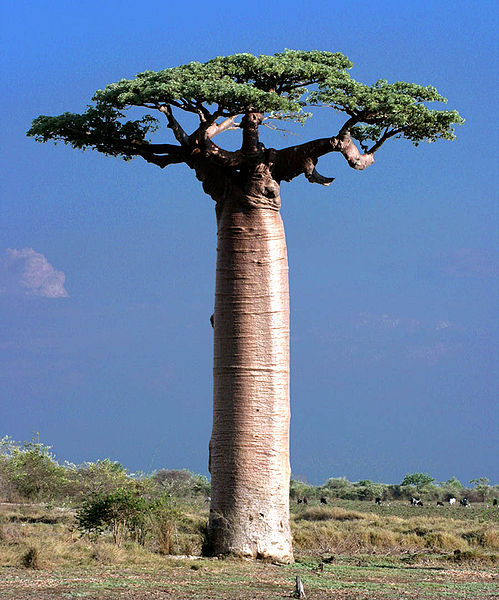
Finally, we couldn't stop thinking about the Broccoli that reminded us of a tree. To prove that we're not crazy... here is a tree that looks like a Broccoli !

Adansonia Grandidieri Baobab, Madagascar
Image credits: Quilt and fabric images are shown with the generous permission of Lonni Rossi.  The photo of the giant Baobab is by Jialiang Gao and is licensed for use under the Creative Commons Attribution License.